

Source: Youtube
Temperature is one of the simplest things to measure, but finding an indoor outdoor thermometer that stays accurate, holds up outdoors, and doesn't become a frustration to use is harder than it should be. A lot of models look fine in product photos and fall apart in practice, with sensors that drift after a few months, displays that wash out in sunlight, or wireless connections that drop the moment a wall gets in the way.
At A Glance: Our Top 5 Picks for Indoor Outdoor Thermometers in 2026
- Best Overall: Ambient Weather WS-2902C
- Runner-Up: La Crosse Technology C85845
- Best Budget Model: ThermoPro TP62
- Best For Multiple Locations: Ambient Weather WS-10
- Best Mid-Range: AcuRite 02027A1
We reviewed the top wireless models across five price points, from basic two-sensor setups to a full home weather station, to find the ones worth recommending. Our top pick is not a traditional thermometer, but a complete weather station that costs more but delivers accuracy and functionality that no standalone thermometer can match. If that's more than you need, we have straightforward options at every budget below it.
Our team of editors independently research, test, and recommend the best products to help you navigate when shopping online. This post contains compensated links, and if you make a purchase using the links included, we may earn a commission. To learn more, read our disclaimer. We follow a strict review methodology for all product recommendations on this site.
| IMAGE | PRODUCT | |
|---|---|---|
Best Overall 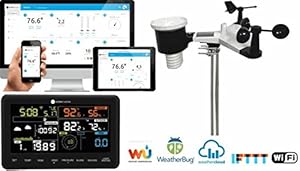 | Ambient Weather WS-2902C
| VIEW ON AMAZON → |
Runner-Up  | La Crosse Technology C85845
| VIEW ON AMAZON → |
Best Budget Model  | ThermoPro TP62
| VIEW ON AMAZON → |
Best For Multiple Locations  | Ambient Weather WS-10
| VIEW ON AMAZON → |
Best Mid-Range  | AcuRite 02027A1
| VIEW ON AMAZON → |
The Best Indoor-Outdoor Thermometer Reviews
Based on extensive research, testing, and a close look at real customer reviews, we have compiled this comprehensive list of the best indoor-outdoor thermometers.
1. Ambient Weather WS-2902C Osprey WiFi 10-in-1: Best Overall
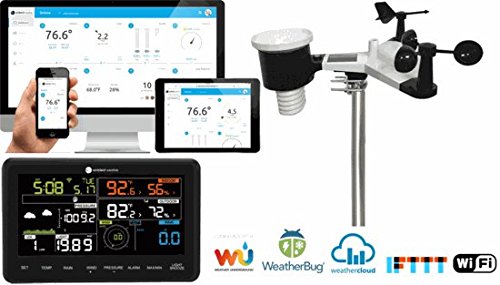
The Ambient Weather WS-2902C is our top thermometer recommendation, and it’s not hard to see why when you review the capabilities of this station.
As you would expect from any wireless indoor outdoor thermometer, the WS-2902C covers the basics: indoor and outdoor temperature and humidity, barometric pressure, forecast, date and time, and daily high and low readings. What sets it apart is everything beyond that. The station also tracks wind speed and direction, rainfall, UV and solar radiation, dew point, heat index, and wind chill, with high and low records and customizable alerts for every parameter. Remote monitoring, smart home integration, and support for up to eight additional sensors round out a feature set that no standalone thermometer comes close to matching.
You can see from this list of functions, the WS-2902C provides a full home monitoring experience. Tracking the correct humidity level for sleeping is one of its features.
Due to its innovative functionality, the weather station is more expensive than standard indoor outdoor thermometers. Yet, at its price point, it represents excellent value for money, which is why we recommend this as our top pick.
All the information from the outdoor sensor is sent to your indoor display every 16 seconds from as far away as 330 feet line of sight or 100 feet under standard conditions. The LCD display receives power via a wall adapter with batteries used as a backup, so you never miss a reading.
The sensor operates wirelessly, and the weather station is powered by a solar panel with batteries used as a backup to ensure that it delivers accurate measurements 24/7.
You can also add up to 8 optional thermo-hygrometer sensors or temperature probes and two air quality sensors (indoor and outdoor) to the system.
Accuracy
Ambient Weather is not a new player in the weather game. They're well known for the accuracy of their home weather systems and based on our experiences and the reviews of other owners of the WS-2902C, this latest model lives up to those same standards.
The consensus is that the weather station software option is one of its best offers.
A key contributor to the accuracy of the WS-2902C is the radiation shielding, which comes as a standard feature on this model.
Radiation shielding minimizes the impact of direct sunlight exposure and encourages natural airflow around the temperature & humidity sensor. The radiation shielding ultimately enhances the accuracy of readings taken during daylight hours.Smart Home Integration
The most exciting feature of the WS-2902C is its integration with smart home software like Google Assistant or Amazon Alexa. Once connected to your smart home system, you can ask your Amazon Echo or Google Home device for an up-to-date report on the indoor or outdoor conditions at your house.
The WS-2902C also has IFTTT compatibility. This means you can set up automatic integration with the other devices in your home to remotely access these and maintain the living conditions. With the WS-2902C, you can control external devices such as sprinklers, blinds, lights, and switches.
WiFi Connected for Remote Monitoring and Reporting
Another great feature of the WS-2902C is the ability to connect the device to Weather Underground and the Ambient Weather Network thanks to the built-in WiFi connection.
Accessing data from these services remotely is priceless. It gives you the ability to view historical and real-time data on your phone, tablet or PC.
Our Top Recommendation
If you want an affordable and user-friendly home weather station that offers many more functions than regular thermometers we highly recommend the WS-2902C.
Pros
- Most accurate sensors
- Includes rainfall and wind measurements
- Smart home integration
- Internet connectivity for remote monitoring
- Best value for money option
- User-friendly LCD display console
Cons
- More expensive than an indoor-outdoor thermometer
- Setup requires more time and effort
2. Best Runner-Up Thermometer: La Crosse Technology C85845
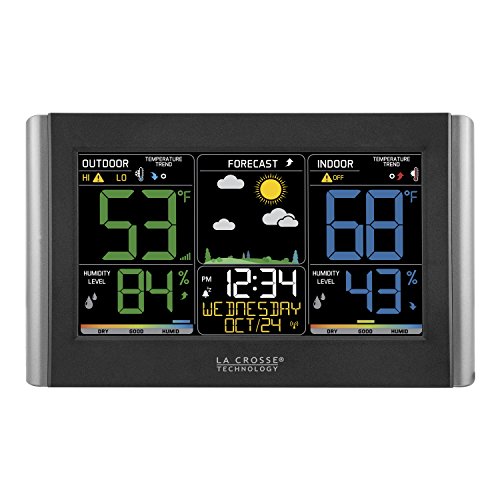
The La Crosse Technology C85845 is a fabulous option if you want a reliable indoor-outdoor thermometer but don’t need all the bells and whistles of our top recommendation. It has quite an attractive design and a bright color display that shows forecast information and the date and time very clearly.
The C85845 provides an accurate reading of the temperature & humidity level ideal at your home, along with a forecast. While the LA Crosse does provide forecasts, there is no barometric pressure reading on the console.
When looking at the console, the color screen is easy to read, and the brightness is also adjustable. You can set customizable alarms based on the temperature & humidity readings and quickly view the minimum and maximum readings for the day.
The console runs off AC power, and 3 AA batteries are required as a backup. The outdoor sensor will need batteries to operate, as well. La Crosse also sells an optional radiation shield for the sensor to improve the accuracy of outdoor measurements. We always recommend using a shield to prevent exposure to direct sunlight.Pros
- Easy to read color display
- Effortless setup
- Dynamic forecasting
- Reliable measurements
- Radiation shield available to add on
Cons
- No barometric pressure reading
- No smart home integration or remote reporting
- Does not measure wind or rain
3. Best Budget Thermometer: ThermoPro TP62 Indoor/Outdoor Thermometer
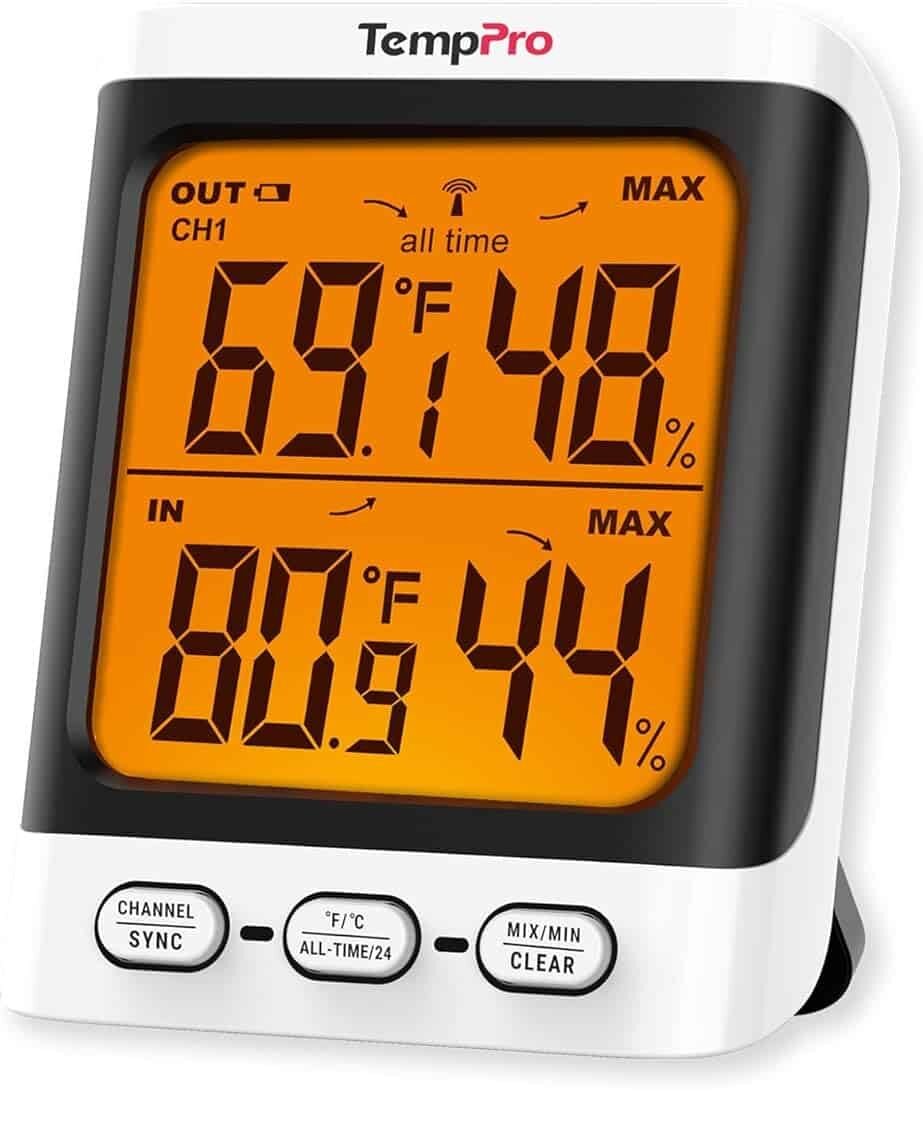
The ThermoPro TP62 is the easiest recommendation on this list. It does exactly what a budget indoor outdoor thermometer should do: accurate temperature and humidity readings, a clear display, and a wireless range that covers most homes, without any unnecessary complexity.
The 3.3-inch backlit LCD is one of the better displays at this price point. It shows indoor and outdoor temperature and humidity simultaneously, along with trend arrows and 24-hour and all-time high and low records. The backlight activates with a touch and turns off automatically to conserve battery. Front-facing buttons mean you can adjust settings without taking the unit off the wall, which is a small but genuinely useful detail.
Wireless range is listed at 200 feet line of sight, and the sensor syncs with up to three additional remote sensors if you want to monitor multiple locations. Accuracy comes in at ±2°F and ±2 to 3% relative humidity, which is competitive for the price. The sensor is rainproof and cold-resistant, so it holds up year-round in most climates.
The TP62 does not provide a forecast, barometric pressure, or any connectivity beyond the local wireless sensor. If those features matter to you, step up to the La Crosse C85845 or the WS-2902C. For straightforward temperature and humidity monitoring at a fair price, it is hard to beat.
Pros
- Easy to read, backlit display
- Affordable price
- Accurate measurements
- Can sync up to 3 outdoor remote sensors
- Extended 3-year warranty
Cons
- Does not provide a forecast
- Only measures temperature and humidity
- No customizable alert settings
4. Best Thermometer For Monitoring Multiple Locations: Ambient Weather WS-10
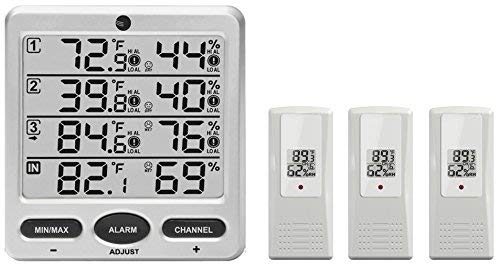
The best model for measuring the temperature and humidity in multiple locations is the Ambient Weather WS-10 Wireless Thermo-Hygrometer. It supports up to eight sensors, including a pool sensor, which makes it perfect for larger homes or properties where you’d want to monitor multiple areas.
The WS-10 includes three remote sensors, and five additional sensors can be added. Plus, there is an integrated sensor inside the display console. Unlike the more premium WS-2902C, the base unit and sensors all run on batteries.
Although a quality battery can last for months at a time, replacing the batteries in up to eight sensors distributed around your home can be a tiresome and costly chore.
The console allows you to set alerts when temperature & humidity readings reach certain thresholds—these alerts display both visually and audibly through the unit. The console also displays maximum and minimum readings for each connected sensor.
Choosing the WS-10 lets you monitor conditions in and around your home, but you will not be getting a full range of readings. While the temperature and humidity readings are important for average users, these provide insufficient information for forecasts.
This product is, without a doubt, excellent value considering the number of sensors it supports, but you miss out on the full range of readings from higher-end indoor-outdoor thermometers.
Pros
- Supports up to eight sensors
- Customizable alerts to notify you of temperature changes
- A pool temperature sensor can be purchased at an additional cost
- Temperature and humidity is displayed on the remote sensors as well as the base unit
Cons
- The display only shows data from four sensors before having to scroll down
- Limited to just temperature and humidity
5. Best Basic Thermometer: AcuRite 02027A1
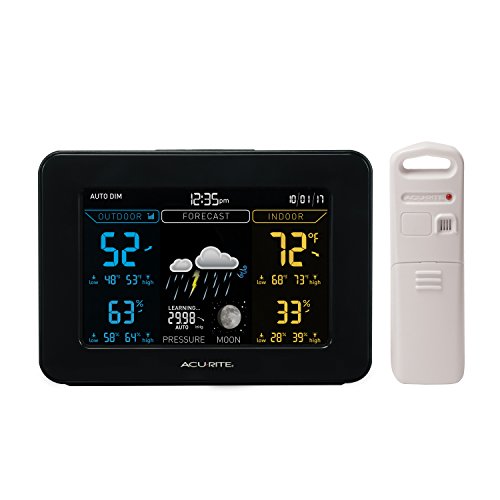
The AcuRite 02027A1 provides indoor and outdoor temperature and humidity readings, forecasts, moon phases, and barometric pressure.
The display console also shows you the date and time, daily high and low readings, and all-time high and low readings. But what’s not provided is the ability to set alerts, internet connectivity, and rainfall and wind measurements.
As a plus, the 02027A1 is easy to set up, and the console is wall-mountable, or you can place it upright on a desk or shelf. Unfortunately, the viewing angles on the display are limited and it can also be hard to read when sunlight hits the screen.
As you can see, this unit has some great features, which makes it a reasonable choice if you cannot justify the price of the WS-2902C. The affordable price tag of the AcuRite 02027A1 also makes it an ideal gift for a weather enthusiast. However, only go for this model if you don’t want or need a full range of sensors or internet connectivity.
Pros
- Easy to set up
- Patented self-calibrating forecasting
- Barometric pressure and moon phase
- Wall mountable or can stand upright on a desktop
Cons
- No alerts
- Limited viewing angles makes the display hard to read
Factors to Consider When Shopping for a Wireless Indoor-Outdoor Thermometer
If you are not a weather enthusiast, then it can be hard to understand what makes a good wireless indoor-outdoor thermometer. There is a whole range of readings and features that you need to decide between and the choice can seem overwhelming.
To help make your decision easier, let’s take a closer look at each of the factors to consider when buying a digital indoor-outdoor thermometer.Included Readings
The first question you need to ask yourself is what measurements are important to you? We suggest the following as the minimum requirements:
- Indoor-Outdoor temperature and humidity
- Barometric pressure
- Forecast
- Date and time
- High and low temperatures
Along with these standard measurements and features, we also find the readings below very useful (especially if you want an accurate and comprehensive local report):
- Wind speed and direction
- Rainfall
Note that you will only find these features in complete home weather stations. After testing many models, the best weather station we have reviewed is the Ambient Weather WS-2902C.
Barometric Pressure and the Forecast
Barometric pressure is the measurement of the pressure that air is exerting on the surface of the earth. More advanced indoor-outdoor thermometers measure barometric pressure.
High air pressure is an indication that air temperatures are lower and can bring blue skies. Low air pressure tends to occur as warmer air rises in the atmosphere. This can cause stronger winds and promote the formation of clouds.
Monitoring air pressure in predominantly sunny locations may show only rare changes, and it can become a bit boring. If you live somewhere with drastic seasonal changes though, you will quickly begin to see the link between changes in weather conditions and air pressure. Observe how barometric pressure in fishing locations can affect your day.
Accuracy
Accuracy is, without a doubt, the most crucial aspect of any instrument. The accuracy rating of indoor-outdoor thermometers are usually listed within a range, just like the temperature and humidity sensor for the WS-2902C:
- Temperature accuracy: ±2°F
- Indoor and outdoor humidity accuracy: ±5%
These accuracy ranges listed above for the WS-2902C are within acceptable limits, and you should not purchase a device with an accuracy range too much outside of this.
Sensor Placement and Radiation Shielding
If you are using outdoor sensors, then you will need to carefully consider their placement. Ideally, the location should be shaded all day and clear of any surfaces that radiate heat—like walls, fences, or windows.
Meteorologists define temperature as the temperature in the shade with plenty of ventilation. Pick a location that is approximately 5-6 feet away from the ground where natural air can circulate freely around the sensor.
If you are not getting accurate readings, try moving your sensor to an open location with constant shade. A useful feature of the AcuRite sensors is the ability to hang them. Many people place them under the eaves of their house, or even in a tree.
If you are finding it hard to locate the perfect shaded spot for your sensor, then consider using a radiation shield. Radiation shields help provide protection and shade for the sensor while still promoting natural airflow around it.
Using a radiation shield increases your options for sensor placement. Even if you think you have the perfect spot for your sensor, we still recommend purchasing a radiation shield for the most accurate readings.
The WS-2902C comes packaged with a radiation shield which allows it to be installed in direct sunlight without impacting on the accuracy of the weather station performance.
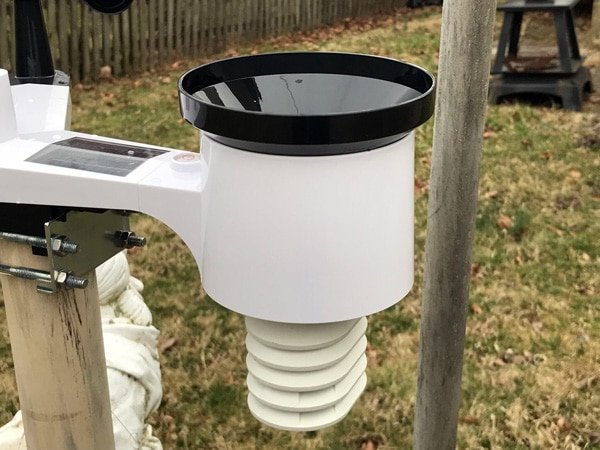
The radiation shield on the Ambient Weather WS-2902C (pictured at the bottom underneath the rain gauge) protects the outdoor temperature and humidity sensor.
Smart Home Integration
If you have other smart devices already, then adding a home weather system is the logical next step. Adding sensors to your automated home is a great way to increase the functionality of your setup by controlling your smart devices to respond to any changes in the weather. If this is your goal, then the WS-2902C is the only device we reviewed that can fulfill this function.
Remote Monitoring and Reporting

Monitor your station's data from any device with the Ambient Weather Network cloud platform.
If you want to access forecast data on multiple devices or share it with other enthusiasts online, then you will need to get a WiFi-enabled model.
The setup for connecting to the Internet using your smartphone or tablet with the WS-2902C is very straightforward and one of the reasons it was our number one pick. Both Weather Underground and the Ambient Weather Network offer great ways for you to share your collected data and view it remotely.
Display

The Ambient Weather WS-2902C has a large, easy-to-read color-coordinated display console.
The display is your primary interface with your wireless thermometer. You need to make sure you choose a device with a high-quality screen to avoid frustration. Here are a few things you should consider about your screen.
Readability
Generally, with screens, larger is better. Bigger screens can display information far more clearly than smaller units, which can sometimes feel cramped. Brightness and viewing angles are also very important, especially for units that are mounted near windows where they’re exposed to sunlight.
Power Source
For the most seamless user experience, choose a model where a wall outlet powers the display. Although many indoor-outdoor thermometers say that batteries can be used, these should only be considered as a backup if the power fails.
The large screens on the indoor units consume a lot of power, and the batteries will lose charge quickly if you rely only on them! For most indoor-outdoor thermometers, when being powered from just the batteries, the display console’s brightness dims right down to preserve power. So it’s best to keep it plugged in for better readability during the day.Mounting Options
You need to give as much consideration to mounting the indoor display console as the outdoor sensors. Don't forget it has its own built-in sensors too!
The display units often have options to free-stand on a tabletop or desk, or you can mount it against the wall. This gives you a lot of choice about where to put the display so it has access to a power socket.
Take care that it is not near any appliances that radiate heat, which can affect your indoor temperature readings.
Additional Sensor Support
Some people need a device that can accommodate many sensors, and for this, we recommend the Ambient Weather WS-10. With three sensors included and support for up to eight sensors in total, you can get multiple feeds of information seamlessly delivered to your display console.
Price
Budget matters, but indoor outdoor thermometers are a case where the cheapest option rarely stays reliable. Entry-level models can give accurate readings initially, but sensor drift, connectivity issues, and build quality tend to show up within a year or two. Spending a little more upfront on a proven model from Ambient Weather, La Crosse, or ThermoPro is a better investment than replacing a cheap unit every couple of years.
Conclusion
After reviewing the top wireless indoor outdoor thermometers available in 2026, the Ambient Weather WS-2902C stands out as the clear recommendation for anyone who wants accurate, reliable data from a single device. It costs more than a standard thermometer, but the accuracy, connectivity, and range of measurements justify the price if you take your home weather monitoring seriously.
If the WS-2902C is outside your budget, the La Crosse Technology C85845 is the most capable of the simpler options, with accurate temperature and humidity readings, a clear color display, and a straightforward setup. For basic monitoring on the tightest budget, the ThermoPro TP65A does the job reliably without unnecessary complications.




I just purchased a La Crosse indoor-outdoor thermometer, and I was wondering where would be the best place to mount it in my home?
North-facing placement is always best as you can avoid radiation from direct sunlight affecting the readings on the panel. Likewise, ensure good ventilation around the control panel and any external sensors to prevent readings picking up any heat from the unit.
We had a serious storm recently, and I was wondering if there’s a way to test whether my indoor-outdoor thermometer is still giving accurate readings?
Yes, you can absolutely test the readings of your indoor-outdoor thermometer. Simply take down one of the external sensors and place it inside an ice bath for at least 20 minutes.
Reconnect the sensor, and check whether the readings have changed to reflect the “freezing” temperatures. Also monitor to check that the temperature increases as the sensor warms up in its usual placing.