
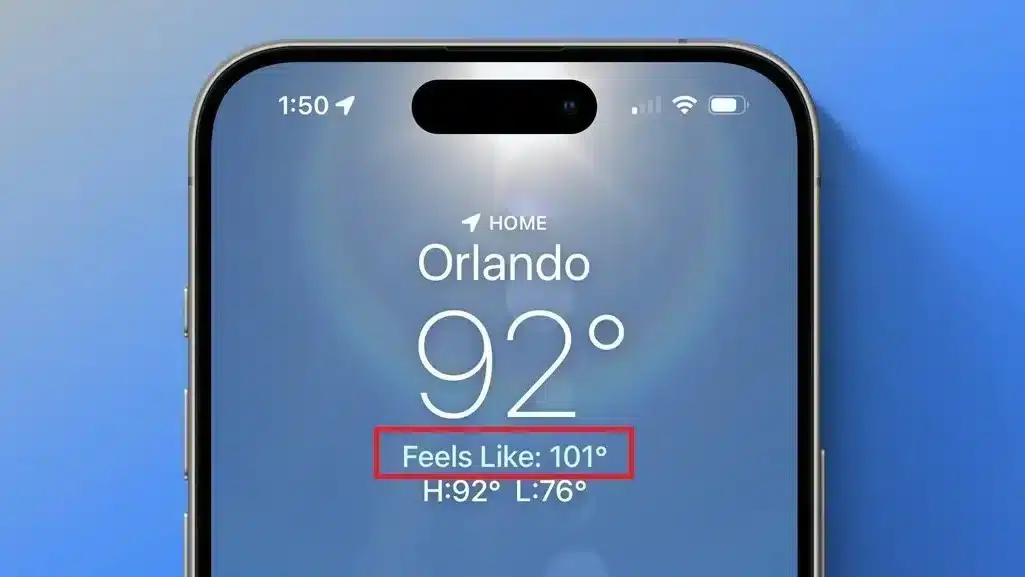
What “Feels Like” Temperature Actually Means
A thermometer measures the thermal energy of the air around its sensor. That number tells you relatively little about what standing outside will actually feel like. “Feels like” temperature, also known as apparent temperature, attempts to answer that more useful question by accounting for the factors that govern how your body gains and loses heat.
Three physical processes drive the result. Wind accelerates heat loss from exposed skin by displacing the warm boundary layer that forms close to the body. Humidity slows the evaporation of sweat, which is the body’s primary cooling mechanism in warm weather, making humid air feel significantly more oppressive than dry air at the same thermometer reading. Solar radiation adds thermal energy directly to the body regardless of air temperature; a 65°F afternoon in full sun can feel noticeably warmer than a shaded 80°F day.
No single formula captures all three effects simultaneously, which is why most weather apps show wind chill in winter and heat index in summer and leave it at that. The calculator above combines all three into a single output, using the same underlying equations the National Weather Service uses for public forecasts, with a solar radiation adjustment on top.
How Wind Chill Is Calculated
The current NWS wind chill formula was introduced in 2001, replacing an older model based on Antarctic research from the 1940s that significantly overstated the cooling effect at moderate wind speeds. The revised equation was validated through human subject trials and measurements of facial tissue cooling rates, making it considerably more accurate for real-world conditions.
The formula is: Wind Chill (°F) = 35.74 + 0.6215T – 35.75(V^0.16) + 0.4275T(V^0.16), where T is air temperature in Fahrenheit and V is wind speed in miles per hour. It applies when temperature is at or below 50°F and wind speed is at or above 3 mph. Outside those ranges, the cooling effect is small enough that the index is not defined.
A common misunderstanding worth clearing up: wind chill does not lower the actual temperature of inanimate objects. Your car engine and an exposed water pipe both respond to the thermometer reading, not the wind chill value. The formula describes the rate at which exposed human skin loses heat. A wind chill of -10°F means your skin is losing heat at the same rate it would in still air at -10°F. That is all it means.
How the Heat Index Works
The heat index equation in wide use today traces back to work by Robert Steadman, published in 1979, and was later adapted by the NWS using a regression equation developed by R.G. Rothfusz. It estimates the apparent temperature a person would feel standing in shaded, calm conditions given a specific combination of air temperature and relative humidity.
The human body sheds excess heat primarily by sweating. Sweat cools the skin through evaporation. When humidity is high, the air is already close to saturated with water vapor and evaporation slows considerably. At 95°F with 60% relative humidity, the heat index reaches approximately 113°F. At 95°F with 30% humidity, it is around 96°F. That 17-degree difference comes entirely from humidity, with the thermometer unchanged.
The Rothfusz equation is valid for temperatures at or above 80°F with relative humidity at or above 40%. Below those thresholds, the humidity effect diminishes to near irrelevance for most people. The NWS applies minor corrections when humidity falls below 13% or exceeds 85% at moderate temperatures; the calculator handles both automatically.
The Solar Radiation Factor Most Calculators Ignore
Most online feels-like calculators stop at wind chill and heat index. Neither formula accounts for direct sunlight, which is a significant omission in practice. Anyone who has sat on a ski lift on a bright March morning, with the thermometer in the low 30s but feeling almost comfortable in direct sun, understands how much solar gain matters.
NWS testing and published meteorological research point to solar radiation adjustments ranging from roughly 4°F under hazy or partly cloudy skies to around 15°F under intense full sun at low latitudes. The adjustment is less mathematically precise than the Rothfusz or wind chill equations because it depends on sun angle, cloud thickness, surface albedo, and the clothing and skin tone of the individual. The values used here (2°F for partly cloudy, 7°F for mostly sunny, and 15°F for full sun) reflect the commonly cited NWS guidance range and represent a reasonable average for a lightly clothed adult at midday in temperate latitudes.
On a 75°F day with moderate humidity and direct full sun, the apparent temperature can exceed 90°F. The same day in deep shade feels like the mid-60s. Both readings come from a thermometer measuring the same air temperature.
Feels Like Temperature Comfort Zones
The table below summarizes how each feels-like range typically affects outdoor comfort, activity planning, and health risk. Ranges are in Fahrenheit with Celsius shown in parentheses.
| Feels Like | Level | Activity Guidance | Health Notes |
|---|---|---|---|
| Below 0°F (below -18°C) |
Extreme Cold | Avoid outdoor exposure if possible | Frostbite on exposed skin within minutes; hypothermia risk |
| 0-32°F (-18-0°C) |
Very Cold | Short sessions only; full winter gear essential | Hypothermia risk if wet or insufficiently dressed |
| 32-50°F (0-10°C) |
Cool | Good for running and cycling with layers | Cold air can aggravate asthma; keep inhaler accessible |
| 50-65°F (10-18°C) |
Comfortable | Ideal conditions for most outdoor activity | No significant health concerns for most people |
| 65-80°F (18-27°C) |
Warm | Comfortable; hydration important during exercise | Stay hydrated, especially in direct sun |
| 80-90°F (27-32°C) |
Hot | Schedule exercise for early morning or evening | Heat exhaustion possible during strenuous activity |
| 90-103°F (32-39°C) |
Very Hot | Limit strenuous outdoor activity; seek shade | Heat exhaustion risk elevated; vulnerable people at significant risk |
| Above 103°F (above 39°C) |
Extreme Heat | Avoid outdoor exertion; stay in air conditioning | Heat stroke risk; a medical emergency if symptoms appear |
Why Input Accuracy Matters
A feels-like calculation is only as good as the data going into it. Weather app readings are sourced from the nearest reporting station, which may be several miles away at a different elevation and surrounded by different terrain and surface cover. An airport weather station reports very different conditions from a residential backyard on a calm summer morning, or a hilltop exposed to wind that a nearby valley does not see at all.
A personal weather station gives you actual local readings for temperature, humidity, and wind speed. The Ambient Weather WS-2902C is one of the most capable all-in-one home stations for this purpose, logging real-time data that feeds directly into a calculation like this one. If humidity precision is the priority, purpose-built wireless sensors like the TempStick offer tighter measurement tolerances than most integrated stations. The best home weather stations guide covers the main options across different use cases and budgets.
Frequently Asked Questions
What is the difference between feels like temperature and heat index?
Heat index is one component of feels like temperature. It describes apparent temperature based on the combination of air temperature and relative humidity, and only applies when temperature is at or above 80°F with humidity above 40%. Feels like temperature is a broader concept: it incorporates wind chill at lower temperatures, heat index at higher temperatures, and solar radiation as an additional modifier across the full range. The calculator on this page combines all three into a single output.
Why does wind make cold temperatures feel so much worse?
Still air near your skin acts as a thin insulating layer. Even in cold conditions, this boundary layer slows heat loss from exposed skin. Wind continuously strips it away, exposing skin to the full temperature of the surrounding air and accelerating heat loss considerably. The effect is most pronounced at low temperatures and moderate to high wind speeds. Above 50°F, the body generates enough metabolic heat to largely offset it, which is why wind chill is not calculated above that threshold.
Does humidity make cold weather feel worse too?
To a lesser degree than it affects heat. Cold air holds very little water vapor, so high relative humidity is uncommon in genuinely cold conditions. Wet cold conditions, such as freezing rain, wet snow, or high humidity near freezing, do increase heat loss meaningfully, because wet clothing loses its insulating properties and wet skin conducts heat away from the body faster than dry skin. Wet, windy, near-freezing conditions can be more dangerous in practice than dry, still conditions at considerably lower temperatures.
How accurate are feels like temperature formulas?
Both the NWS wind chill formula and the Rothfusz heat index equation are validated against human subject data and accurate within a few degrees for most healthy adults under typical conditions. Individual variation is real: fitness level, body composition, hydration, acclimatization, and clothing all affect how a given person experiences a given set of conditions. The solar radiation adjustment is less precise because it depends on sun angle, cloud thickness, and individual factors that no formula can fully capture. Treat the result as a well-informed estimate rather than a physiological certainty.
At what feels-like temperature does heat stroke become a risk?
The NWS classifies a heat index above 103°F (39°C) as danger-level, where heat stroke is possible during prolonged exposure or physical activity. Above 125°F (52°C) is classified as extreme danger. Heat stroke is a medical emergency. Symptoms include hot, dry skin, confusion, rapid pulse, and loss of consciousness. If heat stroke is suspected, call emergency services immediately and move the person to a cool environment while waiting for help.
Can I use a smartphone weather app instead of a weather station?
Weather app data comes from the nearest reporting station, which may be several miles away. In urban areas with significant heat island effects, or in terrain where conditions vary substantially over short distances, app readings can differ meaningfully from actual local conditions. For casual daily planning the discrepancy is usually minor. For activity planning, greenhouse management, or any application where local accuracy matters, a personal weather station at your location gives substantially more reliable inputs for this calculator.
Why does the same air temperature feel different on different days?
Because temperature alone does not determine thermal comfort. A 75°F reading on a dry, breezy spring morning feels entirely different from 75°F on a humid, still August afternoon in full sun. Wind speed, humidity, and sun intensity can shift the apparent temperature by 20°F or more from the same baseline reading. A single thermometer reading leaves out too much of the picture, which is what the feels like calculation is designed to fill in.

Reviewed by Ed Oswald
Expert Reviewer, Weather Station Advisor
Ed has personally installed and tested every weather station model included in this tool across multiple home environments. He has covered consumer technology and weather instruments for Digital Trends, PC World, and the New York Times for over 20 years.
Read Ed’s full bio →