

Humidity is one of those weather measurements that sounds simple until you try to explain it. The number on your weather app represents just one way to measure moisture in the air, and it’s often not the most useful one.
Understanding the difference between relative humidity, absolute humidity, and dew point will help you answer practical questions: will it feel muggy outside today, is your home at risk for mold, and why does 85°F feel unbearable in Georgia but tolerable in Arizona?
What Does Humidity Percentage Mean?
The humidity percentage shown in weather apps and forecasts is relative humidity (RH). It measures how much water vapor the air currently holds as a percentage of the maximum it could hold at that temperature.
The key word is relative. Air’s capacity to hold water vapor changes with temperature. Warm air can hold significantly more than cold air. So a 70% RH reading in summer and a 70% RH reading in January represent very different amounts of actual moisture in the air.
Absolute humidity, by contrast, measures the actual mass of water vapor in a given volume of air, regardless of temperature. It stays constant as long as no moisture is added or removed, even as temperature – and therefore relative humidity – swings throughout the day.

Absolute Humidity vs. Relative Humidity

The cup analogy is the clearest way to understand the difference. Imagine three cups: a 6 oz, a 9 oz, and a 12 oz. Each represents air at a different temperature. The small cup is cold air, the medium cup is warm air, and the large cup is hot air. Each cup holds the same 6 oz of water.
The 6 oz cup is full — that’s 100% relative humidity. The 9 oz cup is two-thirds full — 67% RH. The 12 oz cup is half full — 50% RH. All three contain identical amounts of water, but the relative humidity readings are completely different.
This is why relative humidity spikes overnight and on cold winter days even when the air feels dry. As temperatures fall, the air’s capacity shrinks and the same amount of moisture fills a higher percentage of it. On a hot July afternoon, 50% RH can feel oppressively sticky because the air is holding an enormous volume of water vapor even at that fraction of its capacity.
Dew Point
The dew point is the temperature at which air must cool (without losing any moisture) to reach 100% relative humidity. At that point, water vapor begins condensing into liquid droplets. Near the ground, that produces dew or fog. Higher in the atmosphere, it forms clouds.
Dew point is a direct measure of how much moisture is actually in the air, which makes it more useful than relative humidity for gauging how uncomfortable it will feel outside. You can calculate the dew point for any temperature and humidity reading using our dew point calculator.
Here is a general comfort guide based on dew point temperature:
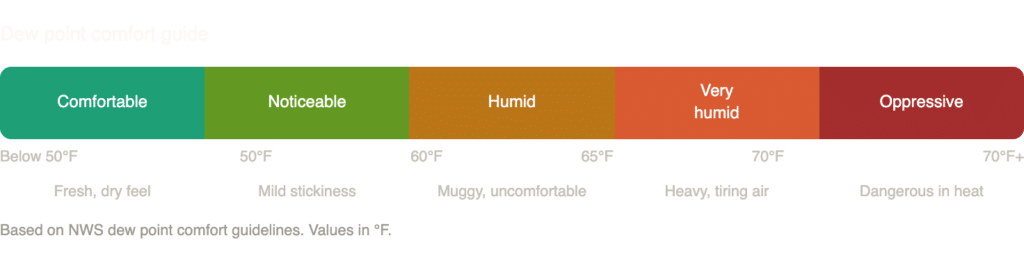
Everyone’s sensitivity varies. People used to Florida summers may find a 62°F dew point unremarkable. Someone from Arizona might find 55°F genuinely unpleasant. But this scale holds as a reasonable baseline for most. You can check current dew point comfort for any conditions with our humidity comfort checker.

What Does 100 Percent Humidity Mean?
100% relative humidity means the air has reached its capacity and cannot absorb any more water vapor. If more moisture enters the air, or if temperature drops, the air sheds water vapor as liquid droplets. Near the ground, that becomes dew or fog. Up in the atmosphere, it forms clouds.
A reading of 100% RH does not automatically mean rain or snow. Precipitation requires water droplets to collide and merge into drops heavy enough to fall. You also do not need surface humidity to reach 100% for precipitation to occur. If enough moisture and lift are present higher in the atmosphere, rain or snow can reach the ground even when surface RH is well below saturation. In very dry air near the surface, falling precipitation can evaporate entirely before it hits the ground. Meteorologists call this virga.

Source: Photo By Lukas Gojda/Adobe Stock
What Causes Humidity?
Humidity enters the atmosphere through evaporation. Water evaporates from oceans, lakes, rivers, soil, and vegetation, rising into the air as water vapor. This is part of the water cycle, and it is constant. On a global scale, the oceans are the dominant source. Locally, a large lake or swamp can noticeably raise humidity in the surrounding area.
Temperature drives the process. Warmer temperatures accelerate evaporation, which is why summer air tends to be far more humid than winter air in most parts of the world. This is also why coastal regions and areas near large bodies of water tend to have persistently high humidity, as there is always an abundant evaporation source nearby.
Wind patterns and air mass movement determine where that moisture ends up. When warm, moist air flows north from the Gulf of Mexico during summer, the southeastern and central United States experiences its characteristic sticky heat. When dry air masses dominate, as they do across the interior West, humidity stays low even during warm months.
Sublimation also contributes a small amount, where ice or snow converts directly to water vapor without melting first, but evaporation accounts for the vast majority of atmospheric moisture.
What is Considered High Humidity?
Outdoors, high humidity is best gauged by dew point rather than relative humidity percentage. A dew point above 60°F is when most people start to notice the air feels genuinely muggy. Above 65°F it becomes oppressive. Above 70°F, prolonged outdoor exertion starts to carry real heat stress risk.
Indoors, the threshold is more objective. The main concern is mold. Mold spores are present in virtually every home – what prevents them from colonizing is keeping moisture low enough that they cannot grow. The EPA recommends keeping indoor relative humidity between 30% and 50%, and no higher than 60%.
High indoor humidity also causes peeling paint and wallpaper, warped wood floors, condensation on windows, and musty odors. Here is a quick reference for indoor RH levels:
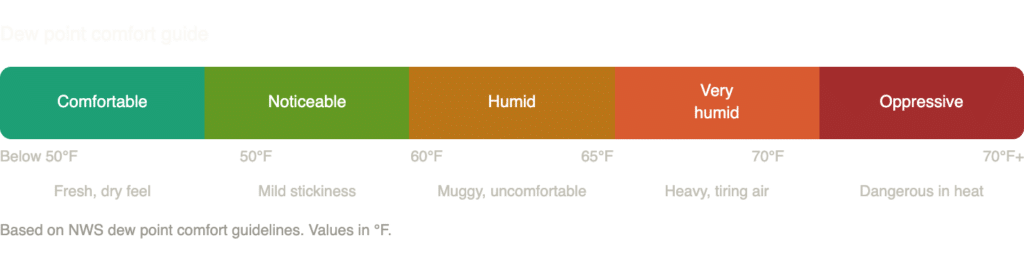
You can measure indoor RH with a hygrometer: a basic model with a display costs around $10 to $15 and is accurate enough for home use. Even without one, condensation on windows, musty odors, peeling paint, and visible mold around window frames are reliable signs that humidity has climbed too high.

Source: Photo By Fevziie/Adobe Stock
How to Lower Indoor Humidity
If indoor humidity runs high, the most effective first step is increasing ventilation. Open windows when outdoor humidity is lower than indoors, run exhaust fans during showers and cooking, and make sure dryers vent outdoors rather than into the living space.
If ventilation alone is not enough, or if you live somewhere with consistently high outdoor humidity, a dehumidifier is the most direct solution. Air conditioning also removes moisture as a byproduct of cooling, though not as efficiently as a dedicated dehumidifier. For a full breakdown of strategies, see our guide on how to lower humidity in your home.

Why Is Humidity So Uncomfortable?
The body’s primary cooling mechanism is evaporation. When you sweat, moisture on your skin evaporates into the surrounding air, carrying heat away from your body in the process. The drier the air, the faster this happens and the more effectively you cool down.
When the air is already close to saturation, evaporation slows significantly. Sweat stays on your skin rather than evaporating, and the cooling effect stalls. Your body responds by producing even more sweat, which still cannot evaporate efficiently. The result is the heavy, exhausted feeling that comes with high humidity heat.
This is why the heat index, or the “feels like” temperature that accounts for humidity, can push apparent temperatures well above the actual air temperature on humid days. A 90°F day at 75% RH can feel closer to 103°F. You can check how humidity affects apparent temperature with our heat index calculator.

Final Thoughts
Relative humidity and absolute humidity both measure the same thing – moisture in the air – but from different angles. Relative humidity tells you how full the air is relative to its capacity. Absolute humidity, expressed most usefully as dew point, tells you how much moisture is actually present.
For outdoor comfort, dew point is the better number to watch. For protecting your home, keep indoor relative humidity between 30% and 50%. If you want to track both, a home weather station or hygrometer will give you real-time readings without any guesswork.
Frequently Asked Questions
What is a comfortable humidity percentage?
Indoors, 30% to 50% relative humidity is considered comfortable and safe. Outdoors, comfort is better assessed by dew point – below 55°F feels comfortable to most people, while anything above 65°F starts to feel oppressive.
Is 70% humidity high indoors?
Yes. The EPA recommends keeping indoor humidity below 60% to prevent mold growth. At 70% RH, conditions are favorable for mold and you should run a dehumidifier or increase ventilation.
What does 100% humidity mean?
It means the air has reached its maximum water vapor capacity at that temperature. Any additional moisture causes condensation: dew, fog, or clouds. It does not necessarily mean it will rain.
Why does humidity make heat feel worse?
High humidity slows evaporation of sweat from your skin, which is your body’s primary cooling mechanism. When sweat cannot evaporate efficiently, body heat builds up and the temperature feels much higher than it actually is. See our heat index calculator for specific feels-like temperatures.
What is the difference between dew point and humidity?
Relative humidity is a percentage that depends on temperature – the same amount of moisture in the air produces different RH readings at different temperatures. Dew point is an absolute measure of moisture content that does not change with temperature, which is why meteorologists prefer it for describing how humid it actually feels.
Can humidity be zero?
In practice, no. There is always some water vapor in the atmosphere, even in the driest desert environments. Humidity approaching zero would only occur in highly controlled laboratory conditions.




Great article! If I wanted to raise the absolute humidity in my home, how would I do that?
You may want to raise the indoor humidity to improve the air dryness in your home. Do this by using the following methods:
– Boil water with a vaporiser to increase the water content of the air
– Raise the indoor temperature, as warm air holds more water
– Switch off fans, as fans distribute the moist air over a larger area, reducing the humidity
Can the air have a zero humidity level?
The air on earth is composed of water and oxygen. Naturally, there can’t be an area with absolute zero humidity readings. While humidity can have a low value, it can’t ever be zero.
Does a higher humidity increase how hot it feels or does it cool things down?
When warm air has a higher moisture content it will feel warmer to the skin. High humidity (or high moisture) increases temperature since warm air holds more water. The more water, the warmer it feels.